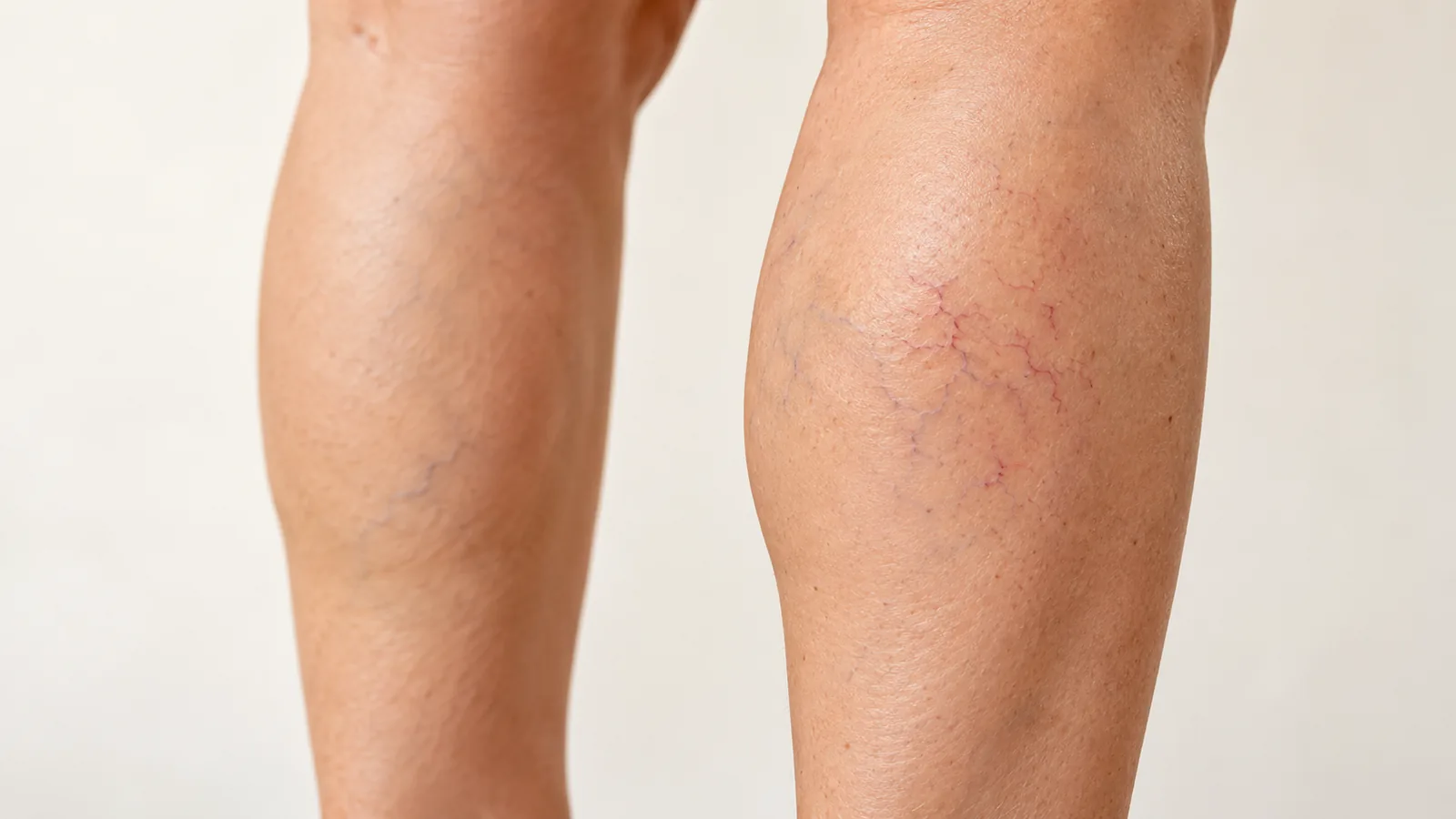
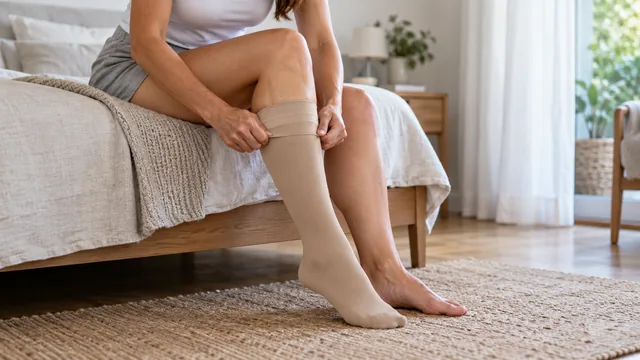
Compression stockings for varicose veins may help manage symptoms or form part of aftercare following certain procedures. However, buying a garment online and selecting the highest pressure is not a safe way to personalise treatment. Indication, size and the ability to use it correctly matter as much as the fabric. At Medivás, an assessment of varicose veins places compression within a wider care plan.
This guide explains what to clarify before using stockings, how to recognise fitting problems and why a therapeutic garment is not necessarily equivalent to a sports sock. It does not recommend one pressure for everyone. Requirements vary with diagnosis, arterial circulation, swelling, skin condition and individual circumstances, including whether putting on and removing the garment is manageable.
What graduated compression does
A compression garment applies external pressure to the limb. In selected venous conditions, it can support blood return and help control swelling or discomfort. Pressure distribution and fit are part of its function. It is therefore not enough for a garment simply to feel tight or difficult to put on; the pressure must be appropriate and distributed as intended.
Compression may relieve symptoms without removing an established varicose vein. It may also be prescribed temporarily after a procedure or for another clinical purpose. Confusing these goals can create unrealistic expectations. Ask whether the garment is intended to manage symptoms, support a phase of recovery or help with another problem, such as a lymphatic component. The answer helps explain both the recommended product and the proposed duration of use.
Pressure, length and size are separate decisions
Different compression levels and designs exist. A knee-length garment and a thigh-length garment are not interchangeable choices based only on convenience. The distribution of the problem, swelling, anatomy and tolerance all influence the recommendation. Commercial descriptions and compression classes can also vary between systems, so retaining the precise prescription is useful when choosing a product.
Sizing requires appropriate measurements rather than shoe size or trouser size alone. A garment that is too loose may not achieve its purpose, while one that rolls down or creates concentrated pressure may cause problems. If leg shape or volume changes, the fit may need reassessment instead of continuing with the same size indefinitely. A well-fitting stocking at one stage of treatment may not remain the right fit after swelling has substantially changed.
Why arterial circulation may need assessment
Veins and arteries have different roles. Before some compression regimens, it is important to assess whether arterial blood supply is adequate. Significant arterial disease can alter the recommendation or make certain pressures unsuitable. Diabetes, reduced sensation and skin lesions also call for careful selection and monitoring rather than a standard over-the-counter recommendation.
It is unwise to suggest strong compression to everyone who describes “poor circulation”. That phrase may refer to quite different conditions. Significant pain, a cold foot or colour changes should prompt clarification of the cause first. The clinician decides whether additional checks are needed before prescribing a garment and whether another aspect of the circulation needs attention before compression is considered.
Putting stockings on without folds or rolled edges
Ask for a practical demonstration of putting on and removing the garment. Fabric should be distributed evenly, avoiding wrinkles that concentrate pressure. Pulling only from the top edge can make fitting more difficult. Donning aids may help when strength, mobility or dexterity is limited, and the choice should reflect what can realistically be managed at home.
Instructions should specify when to put stockings on, when to remove them and what to do if they cause discomfort. Do not assume they should be worn at night: advice may vary with the purpose and stage of treatment. If daily help is needed, discuss this before selecting a garment that cannot be used independently or with available support. A theoretically suitable prescription is less useful if it cannot be followed safely.
Skin care and garment maintenance
Check the skin when removing the stocking, looking for rubbing, pressure areas or injury. Moisturising may be part of care, but timing should allow the skin and fabric to be in an appropriate condition when the garment is put on. Follow the manufacturer's washing and drying instructions; excessive heat or unsuitable products can alter the material's properties.
Compression garments do not retain their characteristics indefinitely. Wear, frequency of use and changes in the body may require replacement or reassessment. If the fit changes, do not solve the problem by folding the top edge or adding a second compression layer on your own. Ask how to review the size, condition and wearing regimen. Keeping track of when a garment was obtained can help make that discussion more practical.
Understanding what happens inside the veins
Blood reaches the legs through the arteries and returns towards the heart through superficial and deep veins. Contractions of the calf muscles help move it upwards, while small valves encourage flow in the right direction. When some valves no longer close effectively, blood can flow backwards through a particular segment. This is called venous reflux and can contribute to increased pressure within parts of the venous network.
The vein visible at the surface does not necessarily explain the whole problem. It may be a branch connected to another vein with reflux, or a small surface change without significant disease in the main superficial trunks. Counting visible veins or looking at a photograph therefore cannot establish the right treatment. An examination connects the appearance with symptoms, distribution and, where appropriate, ultrasound findings.
It is also useful to separate cosmetic concerns from functional effects. Someone may be troubled by small visible veins despite having very little discomfort. Another person may experience heaviness or swelling even though changes at the surface look relatively modest. Both deserve a clear explanation, but they do not automatically require the same investigation, priority or intervention. Symptom intensity is not a precise measurement of the risk of complications either.
Family history, pregnancy, age, previous vascular events and long periods of immobility may all contribute to the overall picture. They do not establish a single cause, and they do not mean that the person has done something wrong. The consultation identifies which factors matter in that individual situation and which can realistically be changed. Understanding this distinction makes it easier to see why everyday measures may ease discomfort without removing an established vein, while a procedure targets a particular part of the circulation. Neither approach should be judged only by how a leg looks in one photograph.
What a complete vascular assessment contributes
An assessment begins with how the problem started, what changes the symptoms and how it affects everyday life. Useful details include whether one leg or both are affected, whether discomfort builds towards the evening, whether walking helps and whether anything has changed recently. Previous blood clots, procedures, pregnancies, medicines and other health conditions are also relevant to circulation and to the safety of possible treatment.
The examination may include visible veins, swelling, skin colour, temperature and skin condition. The clinician may check pulses when this helps assess arterial circulation. Leg discomfort is not always caused by veins: muscle, joint, nerve and lymphatic problems can produce overlapping symptoms. Several causes may exist together, in which case a particularly clear discussion about expectations is important before choosing an intervention.
Duplex ultrasound combines images of the structures with information about blood flow. When indicated, it can assess whether veins are open, the direction of flow and possible sites of reflux. Its purpose is not simply to add a routine test. It should answer questions that could change the diagnosis or the choice of treatment. The findings must be interpreted alongside the history and examination, rather than as a collection of isolated measurements.
Before making a decision, ask for an understandable explanation: which vein is involved, whether the symptoms fit that finding and what treatment is expected to achieve. It is equally reasonable to ask which symptoms might remain if they have a different cause. A sound decision includes alternatives, sometimes including observation. The appointment should end with a practical plan, a reason for each next step and clear advice about when to return. Knowing what uncertainty remains is useful information, not a sign that the consultation has failed to provide an answer.
Comparing conservative care and procedures
Conservative measures and procedures address different goals. Suitable activity, position changes, skin care and prescribed compression may help manage discomfort. They do not necessarily correct the reflux responsible for the problem or remove an established varicose vein. Where intervention is appropriate, the choice depends on anatomy, symptoms, medical history and the person's informed preferences, rather than on a procedure name alone.
Options used for venous disease include thermal endovenous techniques, sclerotherapy and selected surgical approaches. No single method suits every vein. Its location, course, size, relationship to skin and nerves, and the condition of the deep circulation can all change the recommendation. The fact that a technique is available at a clinic does not mean that every patient attending that clinic should receive it.
Useful comparisons cover the main objective, anaesthesia, expected number of visits, likely discomfort, temporary restrictions and follow-up. When a price is provided after assessment, it should explain what is included: investigations, the procedure, materials, reviews and any potential additional treatment. A quotation does not replace a clinical indication, and it should not be interpreted as a promise of a complete or permanent result.
Possible unwanted effects should also be discussed. Depending on the procedure, these may include bruising, inflammation, pigmentation, local discomfort or altered sensation. Less common complications can require medical attention. The clinician should explain the risks relevant to the specific technique and individual circumstances rather than provide an identical list for every treatment. Asking about alternatives, including not intervening, helps put the expected benefit in perspective. Informed consent is an individual conversation as well as a document. Having time to understand the explanation and ask questions is part of that process, even when the proposed treatment is performed as an outpatient procedure.
Building a routine you can maintain
Small, repeatable changes are often more useful than an ambitious routine that cannot fit everyday life. Alternating sitting with movement, walking within personal ability and avoiding long uninterrupted periods of stillness can help leg comfort. Where mobility is limited, the plan should accommodate that limitation instead of imposing a universal step count or a fixed exercise target on everyone.
Ankle movement and calf muscle activity contribute to the muscle pump that supports venous return. Brief movement breaks can be incorporated into a working day when appropriate for the person's clinical situation. Every break does not need to become an intense workout. Gradual, tolerable activity is usually easier to sustain than occasional strenuous efforts followed by prolonged inactivity, and the routine should remain practical when work or family responsibilities change.
When compression is prescribed, the indication and fit matter. Greater pressure does not automatically mean greater benefit. Size, skin condition, the ability to put the garment on and possible arterial disease all need consideration. A garment causing substantial pain, marked colour change or skin injury should not simply be endured without advice. Copying a relative's prescription or extending a post-procedure regimen independently is not a reliable way to choose suitable compression.
Daily care also means noticing the condition of the skin and paying attention to new changes. Rest and comfortable leg elevation may ease some symptoms, but they do not replace assessment when swelling persists or increases. These measures support a clinical plan. They do not guarantee that new varicose veins will never develop, and they do not mean that every symptom should be managed through lifestyle changes alone. A useful routine is one that supports function, can be maintained and has clear limits about when further professional advice is needed.
Warning signs that change the urgency
Not every leg problem should wait for a routine appointment. New swelling that is clearly greater in one leg, especially with pain, warmth or a change in colour, needs prompt medical assessment. Having known varicose veins does not make it safe to attribute every new symptom to them. A photograph or a messaging conversation cannot rule out a deep vein thrombosis either.
Breathlessness, chest pain, fainting or coughing up blood require urgent medical help. In Spain, the emergency number is 112. Trying to manage these symptoms by walking, massaging the leg or taking someone else's medication is not appropriate. An acute problem needs assessment on its own merits, even when a person already has a familiar explanation for occasional leg discomfort.
Bleeding from a varicose vein also calls for action. Lie down, raise the leg if possible and apply firm direct pressure with clean material over the bleeding point. Urgent help is needed if bleeding does not stop, is substantial or the person feels unwell. Even if it settles, the cause should be reviewed to reduce the risk of another episode. A homemade tourniquet should not be used.
Other changes can justify urgent or priority assessment: a wound that is not healing, a red and hot area accompanied by fever or increasing pain, or a foot that suddenly becomes cold, pale and painful. These examples explain the limits of general information; they are not a checklist for making a diagnosis at home. If the seriousness is uncertain, contact a healthcare service able to advise on urgency. A clinic's ordinary appointment channel is not a substitute for emergency services, and waiting for a reply to a non-urgent form is not appropriate when potentially serious symptoms are developing.
Assessing progress without promises of instant results
Follow-up should compare changes that matter to the agreed goal. If the priority was less heaviness, useful questions concern how a working day feels, whether walking is easier and whether rest is more comfortable. If appearance was also a goal, photographs taken under similar conditions may help document change. None of these observations replaces examination when new symptoms develop or the pattern changes unexpectedly.
Some changes after a procedure cannot be interpreted reliably in the first few days. Swelling, bruising or areas of firmness may temporarily affect appearance. The treating team should explain the expected course for the actual technique used and which findings warrant contact before the planned review. It is unwise to assume that everything is normal because treatment was minimally invasive, just as a small bruise does not by itself demonstrate treatment failure.
Reviews may involve a clinical assessment and, where indicated, repeat ultrasound. Their timing should not be copied from someone else's experience because the procedure, medical history and findings all matter. Keeping the initial report, details of the technique and written instructions supports continuity of care. If another centre is consulted later, those documents can reduce incomplete interpretation and unnecessary duplication of investigations.
Venous disease can change over time. Treating one vein does not remove the underlying tendency to develop other abnormalities, and a newly visible vein does not automatically show that previous care was performed incorrectly. The useful question is what has changed and whether there is a current reason to act. Reasonable follow-up combines realistic expectations, access to review when needed and respect for observation when an intervention is not clinically necessary. Progress is best judged over an appropriate period and against a clear baseline, rather than against an advertisement or another person's photograph.
Frequently asked questions about medical stockings
### Are they the same as sports compression socks? Not necessarily. A sports product may use the word compression without matching a particular therapeutic prescription. If a medical stocking has been prescribed, check that the product has the requested characteristics. Advertising about athletic recovery does not replace vascular assessment or establish suitability for a medical condition.
Should I simply get used to discomfort?
A feeling of support may be expected, but substantial pain, new numbness, injury or marked colour change needs review. Do not continue solely because the garment is considered high quality. Correct adaptation is individual and may require changes in size, design, pressure or the underlying treatment plan.
Can I use someone else's stockings?
That is not recommended. Their size, pressure and indication may be unsuitable for you. Even people with similar-looking legs can have different measurements and circulation. Sharing also makes it harder to establish the garment's condition, previous use and maintenance history.
Will I need them for life?
Duration depends on purpose and progress. Some prescriptions are temporary; others form part of longer-term management. A condition such as lymphoedema may require a different plan from an isolated varicose vein. Request written instructions and a point at which the ongoing need will be reviewed.
Where can I ask questions before buying?
You can contact Medivás to arrange assessment and ask what records to bring. A useful prescription explains the reason for compression, the garment's required characteristics and how to check that it is being used correctly in everyday life.
Sources and further reading
- NHS · Varicose veins
- NICE CG168 · Varicose veins: diagnosis and management
- ESVS · Chronic venous disease guidelines
Educational content by Clínica Medivás. It does not provide an individual diagnosis or replace a consultation.
This content is for information only and does not replace an individual medical assessment. Seek appropriate medical care for acute or worrying symptoms.